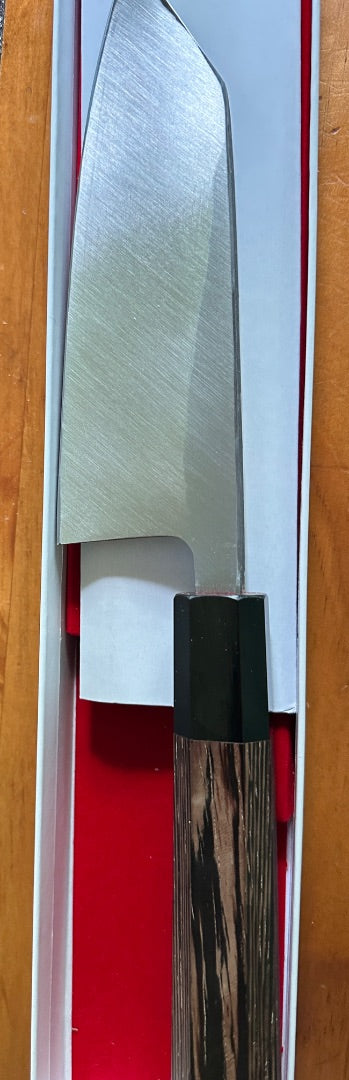
Hatsukokoro Shirasagi
Hatsukokoro Shirasagi Blue #2 Kurouchi Tsuchime Kiritsuke Deba 150
Hatsukokoro Shirasagi Blue #2 Kurouchi Tsuchime Kiritsuke Deba 150
Couldn't load pickup availability
Hatsukokoro Shirasagi Blue #2 Kurouchi Tsuchime Kiritsuke Deba 150mm
This Kiritsuke Deba comes from Hatsukokoro's Shirasagi line, forged by blacksmith Toru Tomura and sharpened by Tateo Myojin in Kochi, Japan. Hatsukokoro is the house brand of a respected wholesaler based in Amagasaki, Hyogo Prefecture, working with a network of skilled blacksmiths across Japan to produce knives ranging from everyday workhorses to high-performance professional tools. The Kiritsuke Deba is a single bevel knife built for fish butchery, combining the weight and edge needed to break down fish cleanly through skin and small bones. Its distinctive K-tip profile gives it extra precision and versatility compared to a traditional deba, making it useful for more detailed work as well as heavier breakdown tasks. The blade is finished in a traditional kurouchi black forged coating with a tsuchime hammered texture, giving it a rustic, handmade look that comes straight from the forging process. At its core is Aogami #2 (Blue Steel #2), a high-carbon Japanese steel valued for its excellent edge retention and the fine, keen edge it can take, making it a favorite among professional and serious home cooks alike.
Specifications
Knife line: Shirasagi
Shape: Kiritsuke Deba
Blade steel: Aogami #2 (Blue Steel #2)
Hardness: approximately HRC 61 to 63
Edge bevel: Single bevel
Cladding: Soft iron, kurouchi tsuchime finish
Construction: Ni-mai
Edge length: 150mm
Blade height at heel: approximately 48mm
Spine thickness at heel: approximately 6 to 7mm
Weight: approximately 230g
Blacksmith: Toru Tomura
Sharpener: Tateo Myojin
Maker: Hatsukokoro
Origin: Kochi, Japan
Care notes
This is a high-carbon steel knife, not stainless, and will react with moisture and acid. Hand wash and dry thoroughly immediately after use, and avoid leaving it wet or in the sink. A patina will develop naturally with use and helps protect the blade, but active rust should be removed. Store with a saya or on a magnetic rack, and avoid cutting frozen food or large bones, as the edge can chip.
Share