1
/
of
4
Okeya Saku
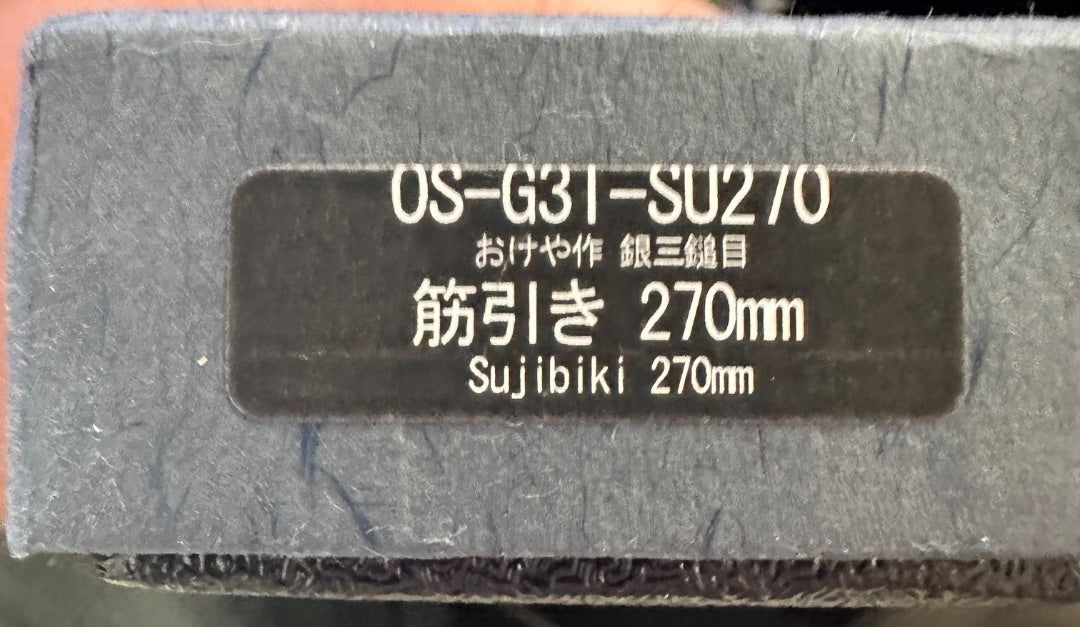
Okeya Saku Ginsan Tsuchime Sujihiki 270mm
Okeya Saku Ginsan Tsuchime Sujihiki 270mm
Regular price
$190.00 USD
Regular price
Sale price
$190.00 USD
Quantity
Couldn't load pickup availability
Okeya Saku Ginsan Tsuchime Sujihiki 270mm
A hand-forged Japanese slicer built for clean, single-stroke cuts
The Okeya Saku Ginsan Tsuchime Sujihiki is a long, narrow slicing knife designed for the kind of work where precision matters — carving roasts, portioning whole fish, and breaking down proteins into smooth, even slices without sawing or tearing. At 270mm, it's the most popular sujihiki length in Japan, long enough to slice through a tenderloin or a salmon fillet in a single pull stroke.
Ginsan steel, the "goldilocks" of Japanese blades
The core is forged from Ginsan (Silver #3), a semi-stainless steel prized for hitting a sweet spot most steels can't: it takes an edge nearly as fine as a high-carbon steel like Shirogami, holds that edge well, and sharpens easily — all while resisting rust far better than a true carbon blade. It's a steel favored by chefs who want carbon-steel performance without the constant babying.
Tsuchime hammered finish
The blade's hammered (tsuchime) texture isn't just decorative — those small forged facets help reduce surface contact and food drag as you slice, so thin cuts of fish or meat release cleanly from the blade instead of sticking.
Made by Okeya
Okeya traces back to 1927 in Miki City, Hyogo Prefecture — part of the Banshu-Miki blacksmithing tradition — where the Fujiwara family began as makers of kogatana and traditional single-bevel blades. Now run by fourth-generation blacksmith Akihito Fujiwara, Okeya brings that same generations-deep forging knowledge to full-size kitchen knives.
Specs
Knife type - Sujihiki (double-bevel slicer)Blade length270mm
Steel - Ginsan (Silver #3), semi-stainless
Finish - Tsuchime (hammered)
Edge - Double bevel, even grind
Handle - Octagonal Walnut
Hand orientation - Ambidextrous
Made in - Japan , Hyogo Prefecture
#### Care
Hand wash and dry immediately after use — do not leave wet or put in the dishwasher. While Ginsan is semi-stainless and far more forgiving than carbon steel, it isn't stain-proof, so a quick dry keeps the blade looking sharp for years.
#### Why you'll reach for it
####
Best for carving cooked roasts and poultry, slicing raw or cooked proteins like brisket and pork loin, and portioning fish where clean, drag-free cuts matter for presentation.
Note: as a hand-finished blade, slight variations in weight, handle grain, and hammer pattern are normal and part of what makes each piece one of a kind.
Share